
Dr. Michelle Hubbard, Agriculture and Agri-Food Canada (AAFC), Swift Current Research and Development Centre
Background:
Chickpea are an important food legume crop in may parts of the world, including Canada, the USA and Argentina. This crop can face challenges including diseases, such as ascochyta blight, wilt and root rot, weeds competing with the crop and drought stress. In south western Saskatchewan, the region of Canada in which most Canadian chickpea are grown, symptoms including whitening of leaflets, wilting or discoloration of upper branches or tips of plants and, sometimes, complete death of plants, was observed, starting in July 2019. This issue has been called the “chickpea emerging health issue”. Similar symptoms were seen in chickpea in Argentina, and referred to as “chickpea yellowing syndrome”. Symptoms have also been seen in the US in Washington, Idaho and Oregon (Dr. Weidong Chen, United States Department of Agriculture), Nebraska (Dr. Bob Harveson, University of Nebraska-Lincoln) and North Dakota (Dr. Uta McKelvy, Montana State University, and Dr. Audrey Kalil, Horizon Resources)
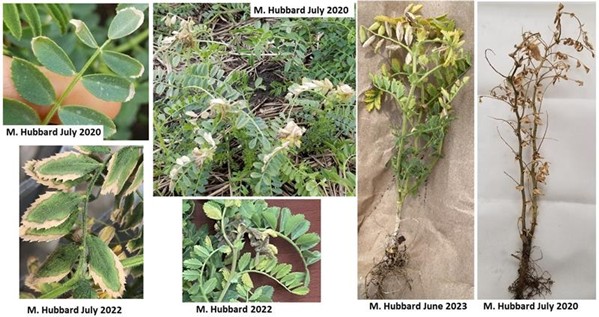
Figure 1: Symptoms of foliar and stem damage observed on chickpea plants during field survey investigation of the chickpea emerging health issue in Saskatchewan, Canada (From Marchesini et al 2025).
In Canada, researchers, agronomists, farmers and the pulse industry have been working to identify potential causes of this health issue ever since in was first noticed. The Saskatchewan Pulse Growers have published reports on their website: Resources Archive | Saskatchewan Pulse Growers and several peer-reviewed scientific articles have been published on the issue (Sharpe et al. 2023 Impact of metribuzin dose and water stress on chickpea plant health – ScienceDirect and Marchesini et al. 2025 Field surveys of chickpea plant damage and association with biotic and abiotic factors in Saskatchewan in 2021-2023). However, the causes are still not well understood.
Potential contributing factors include:
- Drought stress, followed by moisture
- Nematodes, particularly ectoparasitic pin or spiral nematodes, which feed on plant, rather than living inside them and forming cysts or galls
- Stress from herbicides containing the active ingredients metribuzin or group 14 active ingredients
- Phosphorus (P) or potassium (K)
- Crop rotations
- Seed treatments
Future research:
Dr. Michelle Hubbard (AAFC, Swift Current Research and Development Centre) and Dr. Mario Tenuta (University of Manitoba) have recently been awarded funding from the Saskatchewan Ministry of Agriculture, Agriculture Development Fund, Saskatchewan Pulse Growers and Western Grains Research Foundation for a project titled “Exploring the role(s) of pin and spiral nematodes in the emerging chickpea disease in Saskatchewan”.
Discussions of future collaborations, including international work, are ongoing.
Reports
Saskatchewan Pulse Growers. 2020. Saskatchewan Chickpea Plant Health Issue. in S.P. Growers, ed. https://saskpulse.com/resources/saskatchewan-chickpea-plant-health-issue-report.
Saskatchewan Pulse Growers. 2021. Saskatchewan Chickpea Plant Health Issue: 2021 Update. Pages SaskPulse.com https://saskpulse.com/resources/saskatchewan-chickpea-plant-health-issue-2021-update.
Saskatchewan Pulse Growers. 2022. Saskatchewan Chickpea Plant Health Issue: 2022 Update. https://saskpulse.com/resources/saskatchewan-chickpea-plant-health-issue-2022-update.
Saskatchewan Pulse Growers. 2023a. Pulse Agronomy Webinar: Chickpea Plant Health Update. https://saskpulse.com/resources/pulse-agronomy-webinar-chickpea-plant-health-update.
Saskatchewan Pulse Growers. 2023b. Investigating Emerging Chickpea Health Issues in Saskatchewan: Evaluations of herbicides, biostimulants, and potassium chloride fertilization https://saskpulse.com/resources/investigating-emerging-chickpea-health-issues-in-saskatchewan-evaluations-of-herbicides-biostimulants-and-potassium-chloride-fertilization.
Saskatchewan Pulse Growers. 2023c. 2023 Pulse Pest Survey Results. https://saskpulse.com/resources/2022-pulse-pest-survey-results.
Acknowledgements
Research funding was provided by the Agriculture Development Fund, Saskatchewan Ministry of Agriculture, grant number 20200067 and Saskatchewan Pulse Growers, grant number AGR2102, awarded to Dr.
Michelle Hubbard, Dr. Shaun Sharpe (AAFC Saskatoon Research and Development
Centre) and Dr. Jeff Schoenau (University of Saskatchewan).
Limin Luan, Teagan Parkin, Bev Klassen, Rachel Stevenson, Quinn Doane, Dev Patel, Rishi Patel, Keanna Friesen, Maria Erika Pamisaran, Marith Been, Alexandra Cooper, Ria Hamilton, and Prasad Sajeewa Wagachchige for technical assistant.
The following organizations and individuals for survey support: Saskatchewan Ministry of Agriculture (Shannon Chant, Maggy Cooper, Alireza Akhavan, Mackenzie Hladun, Tayo Adegege, Nicole Montreuil, Erica Yaskowich, Jesse Bond) and Plant Health Officers (Betty Johnson, Joanne Kwasnicki), Saskatchewan Pulse Growers (Sarah Anderson, Skylee Woodley, Christina Frank, Mike Brown, Braiden Leppa), Saskatchewan Crop Insurance Corp. (Fred Waelchli, Carolyn Siemens, Amy Wilson, Kiah Simpson, Krysta Erbach, Rebecca Spilchak, Sydney Smith), Cargill Congress, Soils and Such (Melanie Leppa), Prairie Plains Agro (Troy McInnis), Kessler Ag Ventures (Kendall Gee). In kind support from Agriculture and Agri-Food Canada and the University of Saskatchewan in also gratefully acknowledged.
Author Bio:

Dr. Michelle Hubbard is a research scientist with Agriculture and Agri-Food Canada in Swift Current, SK. Dr. Hubbard leads a field, greenhouse, growth chamber and lab based research program on important diseases of pulse crops, including ascochyta blight of chickpea, root rot of pea and lentil and anthracnose of lentil.