
Dr. Zack Bateson, Research Director, National Agricultural Genotyping Center
I was supposed to be turkey hunting. But I came across a scene that fully consumed me on that cool spring morning. Many photos were taken, like I was one of the paparazzi in front of the red carpet but instead of red, this carpet was green. It was the first time I observed a literal carpet of waterhemp seedlings in the field (Image 1). These emerging weeds captured my sense of wonder, which quickly moved to alarm about weed control.
As a geneticist working at a diagnostic laboratory, I researched whether DNA tests could help identify markers associated with herbicide resistance in weeds. Thankfully, research groups have published multiple DNA tests for various site-of-actions (SOAs) using similar detection technology that we have at the National Agricultural Genotyping Center (NAGC).
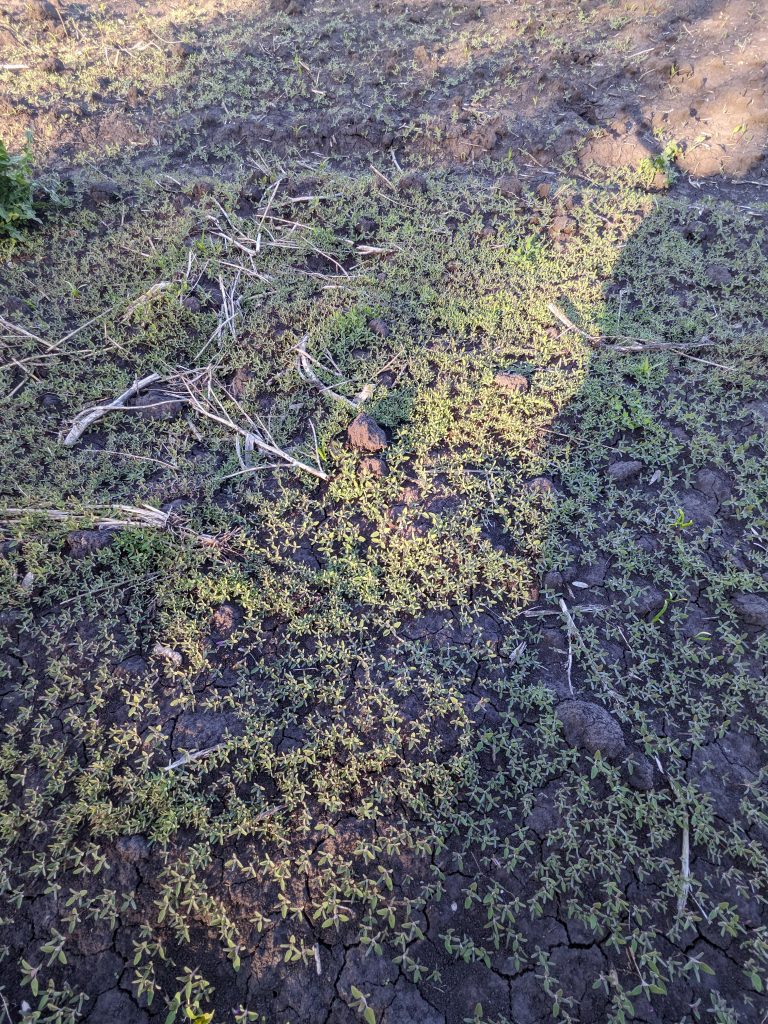
Image 1. Actual photo of the waterhemp carpet that stressed me out.
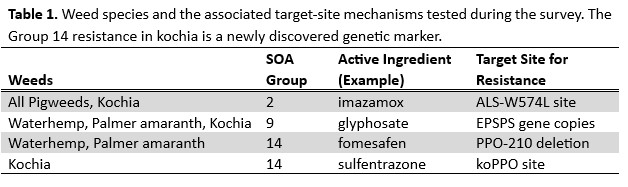
At NAGC, we began validating DNA tests that detect a handful of target-site mutations associated with resistance to Groups 2, 9, and 14 herbicides. DNA testing can get expensive, so – as with any research – we had to limit the scope on what target-sites to pursue. For help with selection, we looked to the ongoing greenhouse trials performed by NDSU weed scientists. By testing the greenhouse survivors across multiple North Dakota weed populations, we decided to focus efforts on the most common target-site resistances within these greenhouse populations (Table 1). As the partnership with NDSU continues, NAGC has been able to validate more DNA tests and offer free testing, all thanks to the amazing support from ND Soybean Council, ND Corn Utilization Council, and ND Department of Agriculture.
Next, we wanted to get the tests, and the results, into the hands of farmers and their advisors. This is a core value at NAGC – provide testing services to the agricultural community. We made pre-paid envelopes, containing a submission form and coin envelopes, to serve as convenient collection kits. Collect a weed, fill out the form, find a mailbox. These kits were the basis for the new statewide genetic screening program for herbicide resistance in pigweeds (waterhemp) and kochia. We kicked off the program in North Dakota in 2023. Below are the highlights.
At the time of writing, we tested 520 weed samples from approximately 80% of counties in North Dakota. These samples were received from August 2023 through November 2024. I will focus on kochia which made up the bulk (n=441) of the samples collected from 37 counties (Fig. 1).

Figure 1. Heat distribution maps, displaying the number of resistant/total kochia tested in each county. Color intensity associated with the total number of resistant samples within counties. The counties without numbers had no samples tested during the sampling period.
Stark County in southwest North Dakota takes the unofficial award for most kochia samples collected. It is important to note that more sampling means more opportunities to find something like resistance markers. This can make it appear as if western ND has the most problems, but with limited testing in eastern ND, it is not a fair comparison. Regardless, we found widespread resistance in kochia as indicated by detecting target-site markers associated with resistance to Group 2 (ALS inhibitors), Group 9 (EPSPS inhibitors), and Group 14 (PPO inhibitors). Combining the genetic data across all three SOA markers showed that 59% (22/37) of counties had all three resistance-related markers within their boundaries.
Lastly, DNA tests allowed us to identify whether stacked resistances were present. That is, how many individual plants contained more than one resistance-related marker. Such information is difficult to acquire with greenhouse trials when plants are sprayed once, with only one SOA herbicide. In our DNA survey, we found 29% (n=126) and 7% (n=33) of tested kochia contained two and all three resistant markers, respectively. The three-way resistant, super weeds were spread across 15 counties (Fig 2.). In conversations with our stakeholders, the widespread Group 14 resistance marker was rather unexpected and quite concerning. Group 14 herbicides in products like Valor, Sharpen and Spartan Charge are used widely in fall and spring pre-emergence herbicide applications for pulse crops to provide residual broadleaf control. There are few other alternatives to control kochia in these crops.

Figure 2. Black counties contained individual kochia that had resistance markers related to all three herbicide groups (Group 2, 9, and 14). Gray counties include those where plants were sampled, but individuals had fewer than three herbicide resistant markers. White counties indicate counties where no samples were collected for this survey. Refer to Figure 1 for a more comprehensive mapping of resistant markers in kochia.
If you stayed this far into the blog post, it is now time to discuss the limitations of the DNA tests used in this survey. NAGC provides confidential reports to submitters who may see a ‘wildtype’ result at the Group 2, 9, or 14 resistance markers. This just means that the specific target-site mutation NAGC detects was not present in the submitted weed. Herbicide resistance can arise due to other target-sites in the genome, including ones still needing to be discovered or other sites not tested by NAGC. Complicating matters are the metabolic or non-target-site mechanisms that cannot be detected by a simple DNA test. Therefore, greenhouse herbicide trials remain the gold standard for detecting all forms of herbicide resistance.
The North Dakota survey is funded into the summer of 2026 and a limited number of collection kits will be available at all NDSU County Extension Offices. We plan to continue to expand this program by validating DNA tests for Groups 1 and 2 within weedy grasses (wild oat and green foxtail). FREE testing is available only within North Dakota, but NAGC’s testing services are available nationwide as a fee-for-service. Weeds and other pests do not respect state boundaries and neither does NAGC when it comes to diagnostic testing support.
I set out for a turkey that spring morning, but a new, more challenging hunt for herbicide resistant weeds took shape.
Short Bio
Zack’s professional training was in wildlife genetics, not agriculture. In fact, he grew up in the dark forests of northern MN and a field with crops was rare. Never mind his childhood and graduate training, Zack is fully committed to agriculture. He is known to stop his car to rip waterhemp and kochia out of the ground, especially in the right-of-way. Geneticists play at the DNA level so whether it is a bird, a bee, or a weed, Zack is happy to explore ways to make genetic tests available to all. Feel free to reach out to Zack through the interwebs: zack.bateson@genotypingcenter.com.