
Rovel Austria, former graduate student NDSU, current address Colorado State University
Audrey Kalil, Agronomist/Outreach Coordinator, Horizon Resources Cooperative
Malaika Ebert, Professor for Dry Bean and Pulse Pathology, NDSU, Fargo, ND
Fusarium root rot is a significant production constraint for peas and lentils in North Dakota and has the potential to cause yield losses in chickpea. Numerous Fusarium species are capable of causing root rot in pulse crops, making it essential to identify the most prevalent species in order to develop resistant cultivars and make informed crop rotation decisions. While Fusarium root rot is well-documented in dry beans and other pulses, the predominant causal species can vary. To assess the impact of Fusariumroot rot on chickpea and identify the specific Fusarium species present in chickpea fields in North Dakota, we conducted root rot surveys during the 2022 and 2023 growing seasons.
In 2022, we surveyed 12 fields in Divide and Williams Counties; and in 2023 we surveyed 16 fields in Divide, Oliver, and Williams Counties. We collected five plants at five, randomly selected locations per field (25 total plants) at early flowering and rated disease severity at the field level. A disease severity index (DSI) of 0% indicates no disease, while a DSI of 100% means that there was severe infection of the plants. The DSI of the sampled chickpea fields in ND ranged from 25.6% to 42.4% in 2022, and from 32.0% to 58.4% in 2023. Root rot severity was below 40% in all but one field from 2022, which had 42.4%. In 2023, 12 of 16 fields had root rot severity between 40 – 60%, while the rest had severity below 40% (Fig. 1).
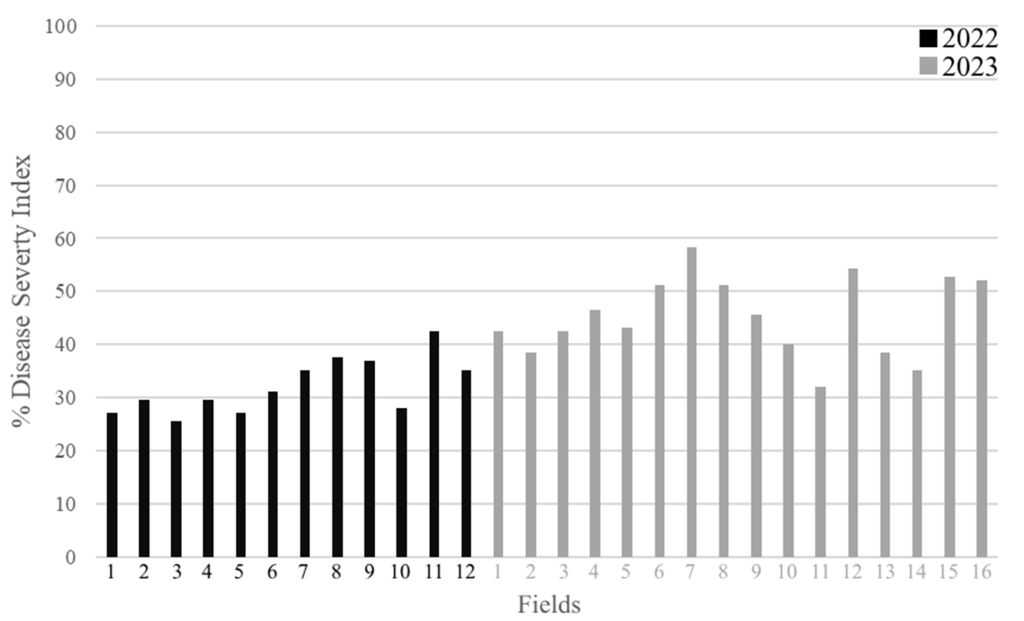
Figure 1. Percent disease severity index (DSI%) for North Dakota chickpea fields surveyed in 2022 (12 fields) and 2023 (16 fields).
Fusarium species isolation and characterization
Fusarium pathogens were isolated from diseased roots and then identified using DNA sequence analyses. We found that Fusarium oxysporum was the most frequently isolated species, accounting for 43% of all Fusarium isolates identified in 2022. This was followed by Fusarium redolens (35%), Fusarium solani (18%), and Fusarium acuminatum (2%) and Fusarium equiseti (2%). In 2023, F. oxysporum was, again, the most frequently isolated (44%), followed by F. acuminatum (27%), F. redolens (24%), and F. avenaceum (4%) (Figure 2).
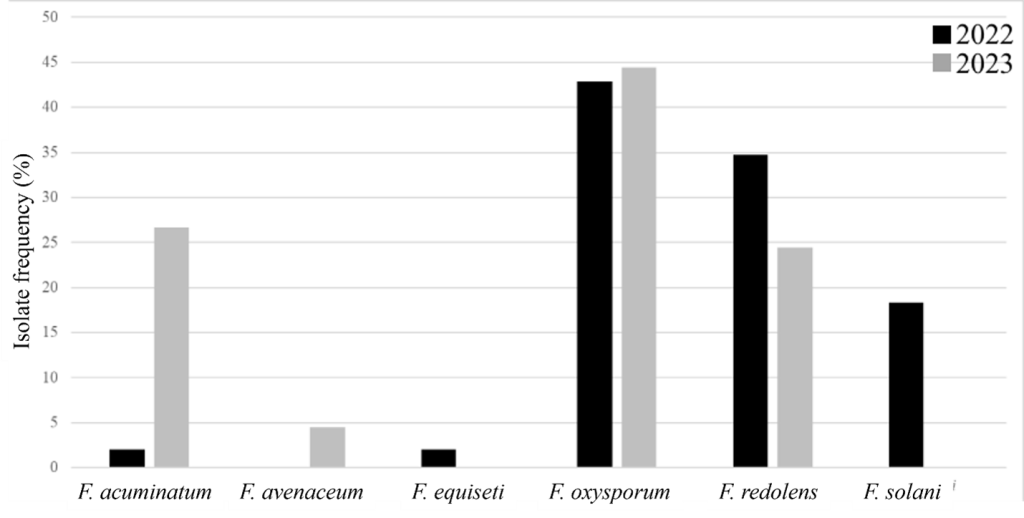
Figure 2. Frequency of Fusarium species isolated from chickpea fields in North Dakota during the 2022 and 2023 disease surveys.
Levels of aggressiveness of identified Fusarium isolates
While these pathogens might be isolated from chickpea roots, that does not necessarily mean they are responsible for causing disease. Therefore, is also important to determine how aggressive these pathogens are to determine their importance in the Fusarium root rot complex. A selection of Fusarium species isolated from diseased roots were individually inoculated on chickpea variety CDC Frontier by soaking the 15 seeds per treatment in a spore solution. Infection assays were repeated three times for all isolates, and disease severity values from the three experiments were combined for statistical analysis. In general, mean root rot disease severity ranged from 52% to 100% in chickpea inoculated with the Fusarium spp., with Fusarium equiseti isolate being the least aggressive on chickpea cv. CDC Frontier (Figure 3 and 4). Out of the 94 individual Fusarium isolates tested in this experiment, 7 strains of F. oxysporum, 2 strains of Fusarium avenaceum, 1 strain of Fusarium redolens, and 1 strain of Fusarium acuminatum displayed 100% disease severity, meaning inoculated plants were completely dead. Except for plants inoculated with Fusarium equiseti, all of the Fusarium species evaluated caused high levels of root disease. F. acuminatum inoculated plants had an average DSI of 91%, F. avenaceum of 100%, F. oxysporum of 91%, F. redolens of 84%, and F. solani of 87%. Furthermore, seedling emergence was reduced in all Fusarium inoculated seeds compared to the non-inoculated control (0% DSI). Seed-soaking with some isolates of F. oxysporum and F. redolens resulted in delayed germination and seedling death shortly after emergence. Moreover, seedlings which appeared to have normal growth above ground had infected roots upon inspection (Figure 3 and 4).
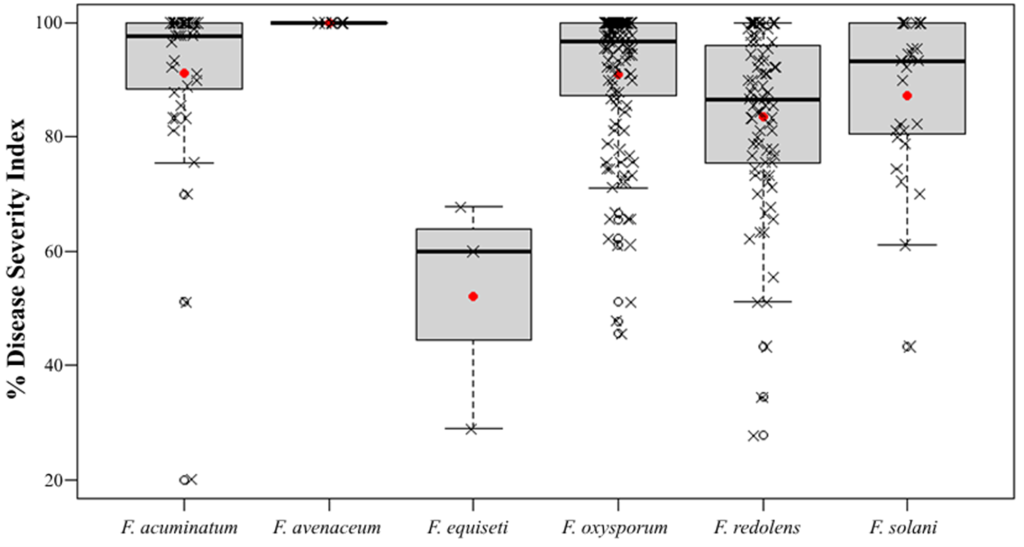
Figure 3. Fusarium root rot severity from greenhouse infection assays of individual isolates from 2022 and 2023 surveys across 3 experimental trials. Number of individual strains tested: F. acuminatum 13, F. avenaceum 2, F. equiseti n 1, F. oxysporum n 41, F. redolens n 28, and F. solani n 9. Means and individual DSI values are denoted by red circles and ‘×’, respectively. Each “x” reflects an average of the 15 plants evaluated in the three experiments.
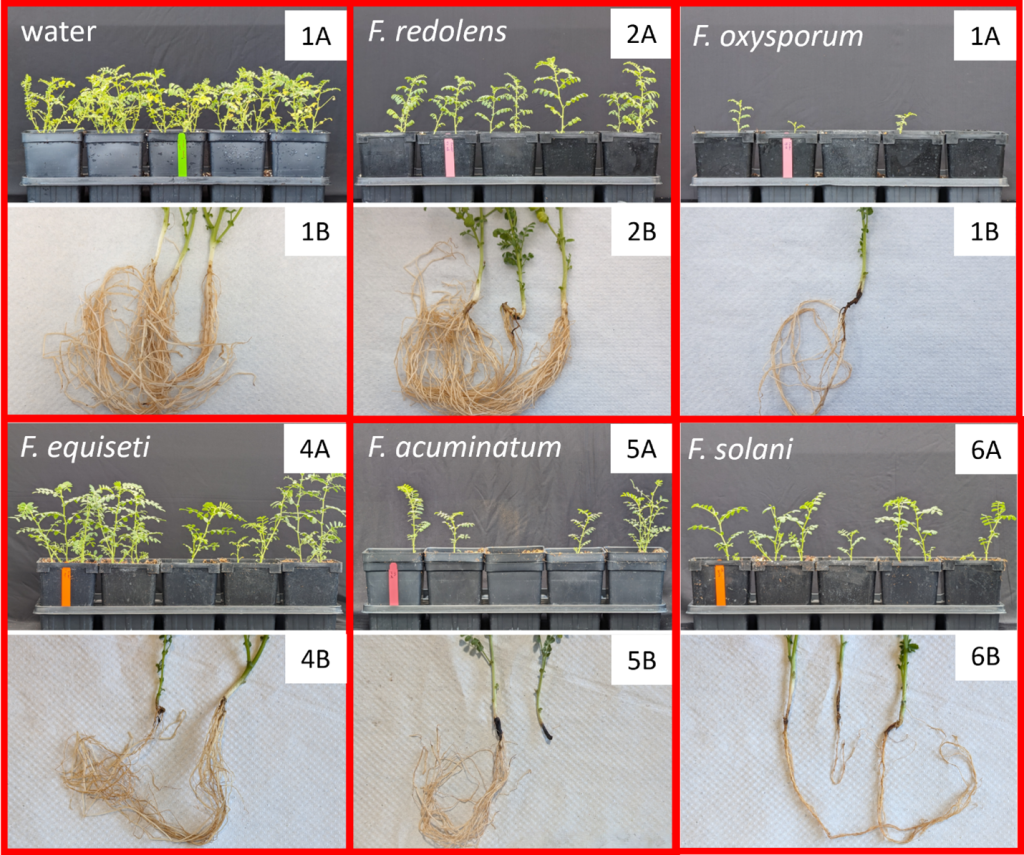
Figure 4. Plant above-ground parts A) and root (B) appearance of chickpea seedlings inoculated with various Fusarium spp. Non-inoculated control (1), F. redolens (2), F. oxysporum (3), F. equiseti (4), F. acuminatum (5), and F. solani (5). Representative root samples uprooted and washed.
This survey found that the Fusarium root rot complex of chickpea is similar to the species which infect pea and lentil in North Dakota. Previous reports have found that F. avencaeum and F. oxysporum are important pathogens of both pea and lentil, and F. acuminatum is associated with root rot in field pea (Zitnick-Anderson et. al., 2020, 2021). F. redolens and F. equiseti has been identified in association with pea roots, but were weakly pathogenic on this crop (Chittem et al. 2015). F. solani is a known root rot pathogen of pea and lentil. Further work needs to be done to determine if there is variability among isolates within species, which affects their cross pathogenicity on pulse crops.
Acknowledgments: This study was funded by the Northern Pulse Growers Association.